
Bleeding Between Periods
Unexpected spotting or bleeding between menstrual periods may need assessment to identify the cause.
Women's Health · Chennai
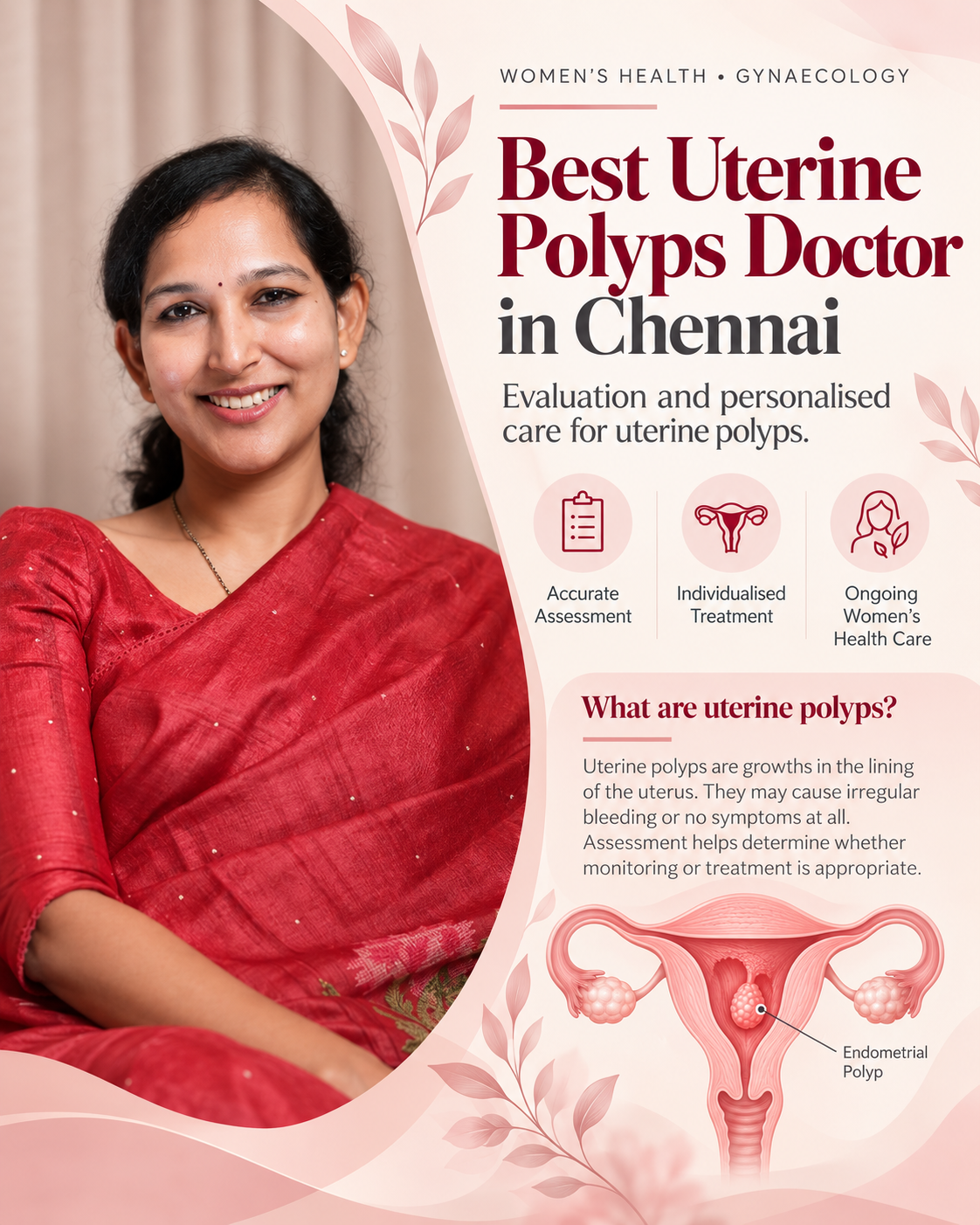
Best Uterine Polyps Doctor in Chennai is a useful starting point when looking for a gynaecologist to assess abnormal bleeding, uterine polyps and related menstrual concerns. Dr. Shruthi Sreedhar offers personalised gynaecological consultations to help evaluate symptoms and discuss suitable next steps.
Uterine polyps are growths that develop from the inner lining of the uterus. They may cause irregular bleeding, spotting between periods or heavy menstrual flow, although some people have no symptoms. Assessment helps determine whether further investigation or treatment is appropriate.
Understanding Uterine Polyps
Uterine polyps, also called endometrial polyps, are growths that form from the tissue lining the inside of the uterus. They can vary in size and may occur as a single growth or as multiple polyps. Most are non-cancerous, but some require further assessment based on a person's age, symptoms and risk factors.
If you are searching for the Best Uterine Polyps Doctor in Chennai, it is important to choose a gynaecological consultation that considers your bleeding pattern, medical history and investigation findings rather than relying on symptoms alone.
Dr. Shruthi Sreedhar provides gynaecological consultations at Ojas Health, Royapettah, Chennai, for women seeking assessment of uterine polyps, abnormal uterine bleeding and related concerns.
Unexpected spotting or bleeding between menstrual periods may need assessment to identify the cause.
Some uterine polyps are associated with heavier menstrual flow or periods that last longer than usual.
Bleeding patterns that change from your usual cycle can have several causes, including uterine polyps.
Any bleeding after menopause should be evaluated by a healthcare professional, even if it is light.
A scan or other investigation may identify a possible polyp even when symptoms are absent.
Some uterine polyps do not cause symptoms and may be discovered during investigations for another reason.
Symptoms and Causes
Symptoms can vary. A gynaecology consultation may be appropriate if you experience:
These symptoms can also occur with hormonal changes, fibroids and other gynaecological conditions. An assessment is needed to establish the likely cause.
The exact cause is not always clear. Endometrial polyps are associated with the growth of tissue in the uterine lining and may be influenced by hormonal factors.
Factors that can affect the need for further evaluation include age, menopausal status, bleeding symptoms, certain medications and relevant medical history.
Irregular bleeding does not automatically mean that you have uterine polyps. Your gynaecologist can assess the symptoms and decide whether imaging or further tests are needed.
Diagnosis and Evaluation
When you consult the Best Uterine Polyps Doctor in Chennai, the evaluation may include a review of your symptoms, menstrual history, medical background and previous reports. The exact investigations depend on your clinical situation.
Your doctor may ask about bleeding dates, flow, duration, medications and any previous gynaecological conditions.
An ultrasound may help assess the uterus and uterine lining and identify a possible polyp or other cause of symptoms.
Depending on the findings, a saline infusion ultrasound or hysteroscopy may be considered to examine the uterine cavity more closely.
In selected cases, blood tests or examination of a tissue sample may be recommended based on symptoms and clinical risk factors.
Treatment Options
Treatment depends on the polyp's size and location, your symptoms, age and clinical findings. Options may include:
Medication may help manage certain bleeding symptoms, but it does not necessarily remove a uterine polyp. Your doctor can explain the available options and their suitability for your case.
Hysteroscopic polypectomy is a procedure in which a slender viewing instrument is passed through the vagina and cervix into the uterus. It allows the clinician to examine the uterine cavity and, when appropriate, remove a polyp under direct visual guidance.
Whether this procedure is suitable depends on the suspected polyp, symptoms, examination findings and individual health factors. Your gynaecologist can discuss preparation, potential risks, recovery and alternatives.
Not every polyp needs the same management. Observation may be suitable in selected cases, while removal and tissue assessment may be recommended in others, especially when symptoms or clinical risk factors warrant further evaluation.
The appropriate plan depends on your assessment. Discuss your symptoms, scan results and treatment preferences with your gynaecologist before deciding on the next step.

Your Gynaecologist
Qualifications: MBBS, MS (OBG), MRCOG (London), FMAS (Apollo)
Dr. Shruthi Sreedhar provides gynaecological consultations for uterine polyps, abnormal uterine bleeding, heavy periods, irregular cycles and other women's health concerns.
At Ojas Health, Royapettah, Chennai, patients can discuss symptoms and investigations and understand the options that may be appropriate for their individual diagnosis.
Appointments · Royapettah
Looking for the Best Uterine Polyps Doctor in Chennai? Contact Dr. Shruthi Sreedhar to request an appointment and discuss abnormal bleeding, suspected polyps or existing scan findings.
Doctor: Dr. Shruthi Sreedhar
Practice: Ojas Health, Royapettah, Chennai
Phone: 089391 02777
Google Business Profile: Dr. Shruthi Sreedhar
Frequently Asked Questions
Answers to common questions about uterine polyps, diagnosis and treatment options.
Uterine polyps are growths that form from the lining of the uterus. Many are non-cancerous, but the need for investigation or treatment depends on symptoms, age and clinical risk factors.
Dr. Shruthi Sreedhar provides gynaecological consultations at Ojas Health in Royapettah, Chennai. You can request an appointment using the form on this page or call 089391 02777.
Possible symptoms include spotting between periods, heavy or prolonged menstrual bleeding and bleeding after menopause. Some polyps do not cause symptoms.
Assessment may include a review of symptoms, pelvic ultrasound and, when appropriate, saline infusion ultrasound or hysteroscopy. The investigations depend on the individual clinical situation.
No. Some polyps may be monitored, while removal may be recommended for symptoms or other clinical reasons. Your gynaecologist can explain the most appropriate approach for your situation.
Hysteroscopic polypectomy is a procedure that allows a clinician to view the inside of the uterus and remove a polyp through the cervix when indicated. The suitability and details of the procedure depend on the case.
Uterine polyps can be associated with irregular or unexpected bleeding. However, irregular periods have several possible causes, so assessment is important to identify the likely explanation.
Yes. Any bleeding after menopause should be evaluated by a healthcare professional, even if it occurs only once or is light, so the cause can be investigated appropriately.
Submit the appointment form on this page or call 089391 02777 to request a consultation at Ojas Health, Royapettah, Chennai.
Related Women's Health Services
Explore related services and information on menstrual health and gynaecology. Verify each page address before publishing these links.